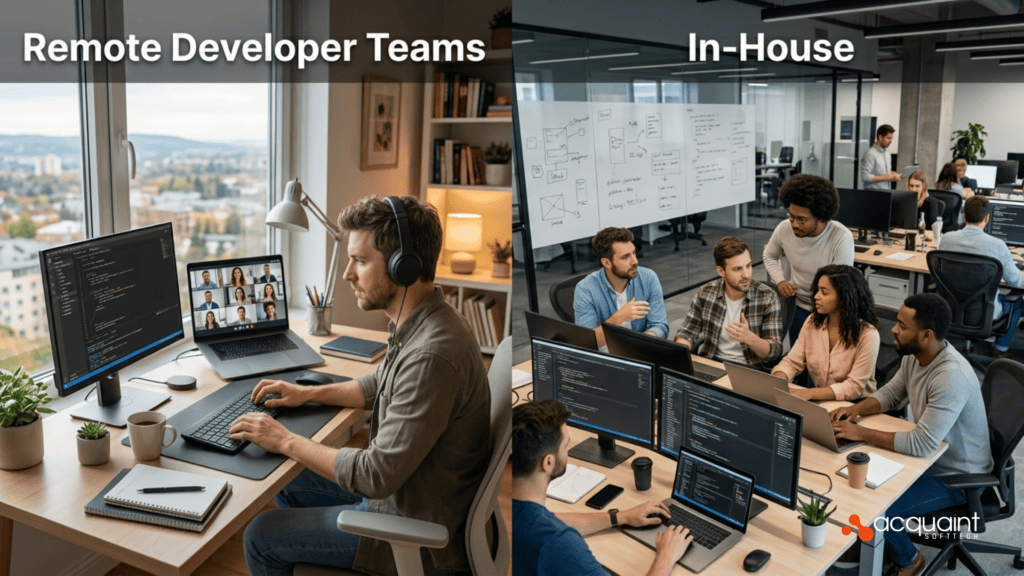
Building software in 2026 starts with a people decision before it becomes a product decision. Do you hire developers who sit in your office, or do you build a team that works from wherever the best talent happens to be?
For most companies, the deciding factor is cost, and that is exactly where the analysis usually goes wrong. Headline salaries tell you almost nothing about what a developer actually costs you over a year of shipping.
This article walks through the true cost of each model, category by category, and gives you a framework to decide which one fits your business today. If you already know you want to test the remote route, you can hire developers who are pre-vetted and ready to deploy, then read on to understand why the numbers line up the way they do.
Why Headline Salary Is the Wrong Number
The instinct is to compare one salary figure against another and pick the cheaper one. The number that actually governs your budget is total cost of ownership, and salary is only the first layer of it. Everything stacked on top of that figure is what quietly decides whether a hire pays off.
For an in-house developer, the extras that rarely make it into the first estimate include:
- Benefits and payroll taxes, which add twenty-five to forty percent on top of base pay
- Office space, hardware, and recurring software licenses
- Recruitment fees plus an average forty-two-day search before anyone writes a line of code
- Management and onboarding time that pulls senior engineers off the roadmap
Once those layers are added, a salary that looked affordable can rise by half again. A remote developer is usually billed at one monthly rate that already folds most of that overhead in, which is why the per-feature cost often lands lower even when the sticker price looks close.
The 2026 Cost Breakdown, Side by Side
The table below sets the two models against each other across the categories that move a real budget. Figures are monthly and reflect a single mid-to-senior developer at current market rates.
| Cost Category | In-House (US) | Remote Team |
| Base pay / monthly rate | $10,000 to $15,000 | $3,000 to $6,000 |
| Benefits & payroll taxes | +25% to 40% | Included in rate |
| Office & equipment | Recurring monthly | None |
| Recruitment cost | Fees + 42-day search | Handled by partner |
| Time to deploy | 4 to 8 weeks | 2 to 7 days |
| Scalability | Slow, fixed | Fast, flexible |
| The quick mathA US mid-level developer at $12,000/month becomes roughly $15,000 to $16,800 once benefits and overhead are counted.A vetted senior remote developer at $5,000/month already includes most of that overhead.That is close to a 60% gap per seat, before you add the recruitment weeks you save. |
What You Give Up, and What You Gain
The Case for In-House
An in-house team gives you immediate collaboration, tight cultural alignment, and a level of control that many leaders value, especially in regulated fields like healthcare and finance. The cost of that comfort is a high fixed structure and a slow hiring cycle that limits how quickly you can reach specialized skills. Location makes it heavier still, since the same role is priced very differently from one city to the next, which is why some teams now look beyond the coastal giants toward rising hubs where the talent-to-cost ratio is stronger.
The Case for Remote
A remote team flips the equation. You reach a global talent pool, which matters when the niche skill you need would never relocate to your office. With a dedicated software development team, you onboard in days, align documentation through a central Knowledge base Software, pay only for productivity, and turn a fixed cost into one that flexes with your roadmap
The trade-off is that you have to invest in clear communication, defined overlap hours, and a partner who enforces coding standards and protects your intellectual property through proper agreements. Whether mobile app developers in Houston can match the output of a coastal team is one small example of the wider move toward cost-aware, location-flexible hiring.
How to Choose a Remote Partner
A remote model only pays off if the partner behind it is solid. Treat the selection the way you would treat any serious vendor decision, and weigh a few things before you sign:
- Verified client reviews and a delivery track record you can actually check
- Transparency about who you are getting, not a generic slot filled later
- A structured vetting process rather than self-reported skills
- Written commitments on overlap hours, code review cadence, and intellectual property
The same discipline that goes into shortlisting the top mobile app development companies applies to choosing a development partner of any kind. Scrutinize the people and the process, not just the monthly rate on the quote.
It also helps to know exactly which engagement you are buying, since a good partner will map its software development services to your stage rather than pushing a one-size-fits-all contract.
Match the Model to Your Stage
There is no single right answer, only the right answer for where your business sits now:
- Early-stage startups usually win with remote teams, where tight budgets and moving product-market fit make flexibility worth more than a shared office.
- Growth-stage companies often run a blended model, keeping a small in-house core for product context and extending capacity with remote developers for specific modules.
- Enterprises with heavy compliance needs may keep more work in-house, yet still use remote teams for non-core systems and hard-to-source skills.
For a deeper look at the speed and talent trade-offs behind these choices, this strategic guide to hiring remote versus in-house developers in 2026 breaks the comparison down further and pairs well with the cost view above.
To Wrap Up
Stop comparing salary to salary. Add every layer of the in-house option, set it against the all-in monthly rate of a remote team, then weigh how fast you need to ship, how specialized the work is, and how much management time you can spare. In most 2026 scenarios, particularly for startups and growth-stage products, a remote or blended model delivers more output per dollar without giving up quality when the developers are properly vetted. Run the real numbers instead of the headline ones, and the decision tends to make itself.

Matt Henry
Matt is a results-driven SEO and outreach expert with a passion for helping businesses boost organic traffic, earn high-authority backlinks, and dominate search rankings. With over 5 years of experience in link building, technical SEO, and digital outreach, Faran stays on top of Google’s ever-evolving algorithms and SEO best practices. As a contributor to leading marketing blogs, Faran shares expert insights, proven outreach strategies, and actionable SEO tips to help brands grow sustainably. Whether it’s launching powerful link building campaigns or fine-tuning on-page SEO, Faran is committed to delivering long-term digital success. 📢 Follow Matt for cutting-edge SEO tactics and outreach strategies that actually work!
Facebook |