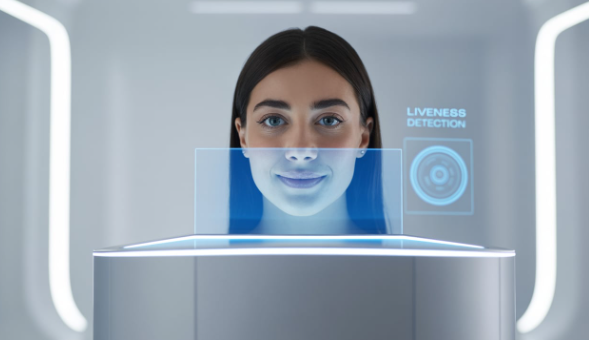
With digital onboarding becoming the default of every bank, fintech, medical site, and online shopping platform, it has never been more crucial to ascertain whether an individual is a real human being, not a spoof, deep fake, printed image etc. Liveness detection, in this case, transforms. Liveness detection is a developed biometric security mechanism that is created to validate the person in the camera is not a video or mask or a picture or someone else, rather physically present. Modern liveness detection software has been advanced and it utilizes AI, machine learning, and computer vision to provide businesses and users with smooth, effective, and secure experiences.
What Is Liveness Detection?
Liveness detection is a biometric authentication procedure which identifies whether a captured face or fingerprint is of a real and a live individual. The system analyzes natural aspects of the human beings including micro-expressions, subtle movements of the head, or eyes, pattern of skin texture, and real-time depth in order to determine true presence. Due to this fact, liveness detection services as an internet-based method has become a crucial component of digital onboarding, eKYC processes, secure authentication, passwordless identity verification, and fraud prevention systems.
The mechanism of Liveness Detection.
Liveness detection is based on three main steps. To begin with, the system will record live data through camera or biometric sensor. This is the first phase which is aimed at capturing live pictures, videos or facial movements. Second, the AI analysis starts. Machine learning algorithms analyze the obtained data to find the evidence that validates or refutes the fact that a person is a real one. The software will match the features and moves of the user with familiar spoofing patterns like printed photographs, masks, deepfakes and screen records. Lastly, the system introduces the outcome, which is either authenticating the user or refusing the user attempt in case of any suspicious or artificial activity in the system.
Types of Liveness Detection
It is usually classified into active liveness detection and passive liveness detection which provide a varying user experience and interaction.
Active liveness verification involves user interaction. The system can request the user to blink, turn his head, smile, or do any other movements. These measures will help a lot in eliminating any possibility of fraudsters deceiving the software with photos or pre-recorded videos. Due to its interactive design, active liveness detection is employed in high-risk verification processes, including banking transactions, fintech onboarding, and password reset processes.
Passive detection, however, is a background-based technology. It does not demand any movement or action on the side of the user. Rather, the program is based on sophisticated AI software to evaluate depth, light reflection, face texture, skin contrast, and natural micro-motions. This allows passive liveness detection to be much more seamless and faster, and the user experience of onboarding is frictionless. It commonly finds application in identity verification schemes of large scale, e-commerce web sites, ride-hailing software, and subscriptions.
Advantages of Liveness Detection.
Liveness detection service can be of great security and operation advantage to contemporary digital enterprises. Among the most valuable benefits, there is the possibility of preventing spoofing and deepfake attacks. Fraudsters are increasingly relying on AI-generated images and fake identities, making fairly old methods of selfie verification inadequate. The detection assists organizations to be ahead of these threats by providing only real human beings to be verified.
The technology further reinforces online identity checking which is essential to highly regulated sectors like the financial, health, insurance, and telecommunication sectors. Detection not only augments security but the customer experience is also better. The latter (especially passive liveness detection) eliminates the friction involved, enabling the user to complete the onboarding or a login procedure in a few seconds. Also, liveness detection minimizes financial losses arising due to identity fraud and facilitates international KYC and AML regulations.
Application Areas of Liveness Detection.
Online detection has emerged as security layer in a number of industries. In banking and fintech, it allows opening digital accounts safely, payments, and authentication of transactions. It is used by crypto exchanges to eliminate account takeovers and identify suspicious activity in real time. In telemedicine and access to a digital health record, healthcare platforms use detection software to verify patient identities. It is applied in government institutions on digital passport validation, national identity systems, and online voting solutions. On-demand applications and e-commerce platforms like ride-hailing services and delivery services use liveness detection to authenticate customers, sellers, and drivers.
The How-To Guide to selecting the Liveness Detection Software.
The choice of the appropriate detection solution is conditional on accuracy, speed, and compliance. In a bid to have good anti-spoofing powers, many businesses seek to have ISO 30107-3 certified systems. The speed of processing and ease of use is also important during the selection of a solution to use, particularly where thousands of users are born in a single day. Another necessary attribute is integration capability, the software must be able to be easily integrated with mobile applications, websites, and back-end systems using APIs or SDKs. The use of deep fake detection as a modern liveness detecting service is also necessary to prevent new threats presented by AI. Lastly, companies have to select tools that are functional in various populations, lighting conditions, and the types of devices.
Liveness Detection of the Future.
The future of active liveness detection is heading to the direction of smarter, real time, and invisible verification. It is also possible to have AI models that are able to detect complex deepfakes in milliseconds and even on low-quality or low-light cameras. The process of verification will be speedy and more convenient, and it will eventually result in passive authentication, where the user will not be involved. Liveness detection also will be synchronized with voice biometrics and behavioral trends and document verification to establish multi-layered identity protection systems.
Final Thoughts
Liveness detection is fast emerging as an important element of safe digital identity verification. Due to the increasing sophistication of identity fraud techniques, companies need to use both active detection and passive detection to safeguard their platforms and users. Through modern detection software and AI-enabled detection services, organizations would be able to enjoy increased security, enhanced trust, and an enhanced user experience in all digital interactions.