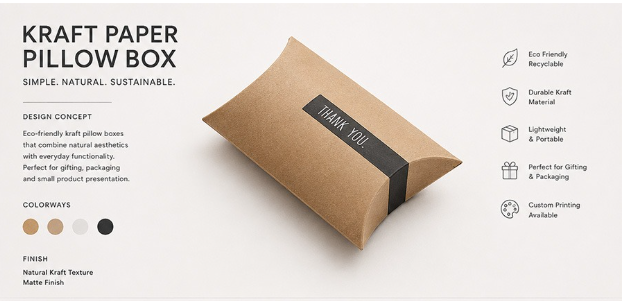
Small products have a packaging problem that rarely gets discussed. Order something tiny – a pair of earrings, a phone cable, a little candle – and there’s a good chance it shows up drowning in packing paper inside a box built for something four times its size. That box was probably already sitting on a warehouse shelf, so it got used, size mismatch and all. Anyone who’s opened a package and laughed at how much empty air came with their tiny purchase knows the feeling. Pillow boxes exist mostly to fix that, and the kraft version of them has become a favorite for brands trying to protect something small without burying it in packaging it doesn’t need.
What a Pillow Box Actually Is
The name comes straight from the shape. It’s a curved, slightly rounded box that looks a bit like a pillow once it’s sitting flat on a table. Usually it’s one folded piece of material – no separate lid, nothing extra to lose track of or mismatch during assembly. That simplicity is a big part of why it works so well for smaller items. Less material goes into it than a standard box, there’s barely any assembly involved, and the curve itself naturally cradles whatever’s inside without needing padding stuffed around it.
Kraft pillow boxes take that shape and are built from kraft paperboard rather than glossy coated stock. That one swap changes more than just the color. Kraft material tends to be sturdier for its weight; it holds a crease cleanly and gives the box a natural, textured feel that a lot of brands genuinely want these days, rather than settling for.
Why Small Products Benefit the Most
A few reasons this shape and material combo works so well for smaller items:
- The curved shape holds a product snug instead of letting it rattle loose inside
- There’s almost no wasted interior space, which cuts down on filler material
- The compact footprint keeps shipping costs down compared to a bulkier box
- The kraft texture makes even a very small item feel like it got real packaging, thought instead of an afterthought
That last point matters more than people expect once you’re selling jewelry, small cosmetics, phone accessories, or candles. A tiny item in a huge box can read as wasteful, even careless, no matter how good the actual product is. A pillow box sized close to the item sends the opposite message – somebody actually thought about how this specific thing should travel and get handed over.
Where They Show Up Most
Pillow boxes have found a home across a wide range of small-product categories:
- Jewelry – earrings, small pendants, rings
- Cosmetics – lip balms, small skincare items, sample sets
- Candles – votives and smaller jar candles
- Phone accessories – cables, small cases, pop sockets
- Gift add-ons – the little extra tucked into a bigger order
Kraft Pillow Boxes vs. Other Small-Item Packaging
| Packaging Type | Protection | Cost | Presentation | Waste/Sustainability |
| Kraft pillow box | Good for lightweight items | Low-medium | Natural, textured, premium-feeling | High recyclable, often compostable |
| Plastic clamshell | High for fragile items | Low | Can look cheap, hard to open | Low – rarely recycled |
| Standard folding carton | Good, more rigid | Medium | Clean but generic unless custom printed | Medium-high |
| Glossy printed box | Good | Medium-high | Polished but less “natural” feel | Medium – depends on lamination |
Printing and Branding Options
Printing on kraft stock has come a long way in a relatively short time. It used to mean plain brown material with maybe one stamped logo, nothing more. Now, full-color printing, fine detail, and even photo-quality graphics go straight onto kraft board without wiping out that natural texture underneath.
That’s part of why natural kraft pillow packaging boxes with custom printing have turned into such a common request among smaller brands. It lets them keep that raw, sustainable-feeling material while still having a look that’s clearly theirs, rather than a plain box that could belong to anyone selling anything. A logo, a pattern, a short brand line – all of it can go directly onto the surface without needing a sticker or extra label slapped on top.
Durability Without Overbuilding It
There’s a balance worth striking here. Kraft pillow boxes were never meant to be indestructible – they’re meant to be appropriately protective for what’s inside, without turning into more packaging than the product actually calls for. A heavier item still needs a sturdier box or some internal padding. But for genuinely lightweight products, a well-made kraft pillow box holds its shape through normal handling and shipping without needing to be built like a tank.
Board thickness matters more than most people assume when ordering these. Too thin, and the box can crush or lose its curve in transit. Too thick, and it starts working against the entire point of a pillow box: staying compact and light. Nailing that thickness for the specific product going inside is usually where a decent packaging supplier separates itself from a mediocre one.
Finding the Right Supplier
Because pillow boxes are simple in construction, it’s easy to assume any packaging company can make them well. In practice, quality varies more than people expect – how consistent the crease is, how well the curve holds its shape over time, how evenly printing lands on kraft stock. All of that shifts noticeably from one manufacturer to the next.
A company like The Premier Packaging works specifically with kraft and paperboard materials, which usually means more consistency across a bulk order and fewer surprises once a custom design actually gets printed on the finished box. For brands that need a clean, repeatable look across every single unit they ship, that kind of consistency is worth more than it might seem on paper.
FAQ
Are Kraft pillow boxes strong enough for shipping, or just for retail display?
They work for both, as long as the board weight matches the product. Lightweight items ship fine in a well-made kraft pillow box; heavier or fragile items may need extra internal padding or a sturdier box altogether.
Can Kraft pillow boxes be printed in full color?
Yes. Printing technology has advanced to the point where full-color designs and fine detail can be printed directly onto kraft stock without losing its natural texture, which is why custom-printed kraft pillow boxes have caught on so quickly with smaller brands.
Are Kraft pillow boxes actually recyclable?
Most are, and plenty are compostable too, depending on the finish. Avoid boxes with heavy plastic lamination if compostability matters to you, since that coating slows down breakdown.
What size products work best in a pillow box?
Small, lightweight items – jewelry, cosmetics, candles, small accessories – tend to fit best. Anything heavy or bulky usually belongs in a standard box instead.
Is custom printing on kraft pillow boxes expensive?
Not particularly. Kraft stock takes printing well without needing extra coating, which keeps costs reasonable even for detailed or full-color designs.
Final Words
Kraft pillow boxes are one of those packaging solutions that quietly solve a problem rather than draw attention to themselves. They fit small products the way they’re actually supposed to fit, protect what needs protecting, and skip the extra bulk so much packaging defaults to out of habit rather than necessity. For brands selling smaller items, that mix of real protection and genuine presentation is hard to beat – and it’s a big part of why Kraft pillow boxes have turned into such a common choice rather than a niche one.

Matt Henry
Matt is a results-driven SEO and outreach expert with a passion for helping businesses boost organic traffic, earn high-authority backlinks, and dominate search rankings. With over 5 years of experience in link building, technical SEO, and digital outreach, Faran stays on top of Google’s ever-evolving algorithms and SEO best practices. As a contributor to leading marketing blogs, Faran shares expert insights, proven outreach strategies, and actionable SEO tips to help brands grow sustainably. Whether it’s launching powerful link building campaigns or fine-tuning on-page SEO, Faran is committed to delivering long-term digital success. 📢 Follow Matt for cutting-edge SEO tactics and outreach strategies that actually work!
Facebook |