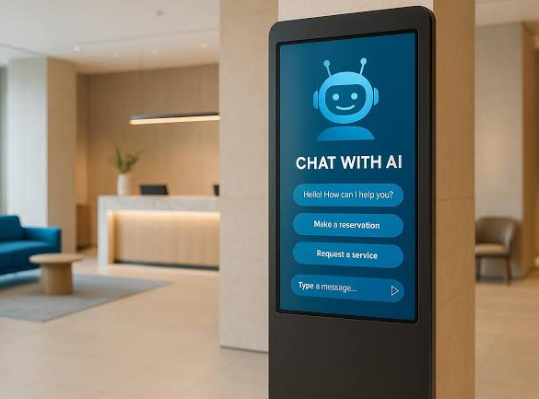
The hotel industry in the UAE evolves, given the intelligent ways in which hotels have sought to manage guest expectations and offer exceptional services. From Dubai luxury resorts to Abu Dhabi business hotels, tourists respond quickly, receive personal advice, and are booked. Traditional customer support practices can have problems following up on the situation, particularly during the major tourist season, when hotels receive hundreds of different questions about communication channels.
AI chatbot for hotels will help hotel agencies to react to questions about guests, facilitate bookings and provide support without needing personnel to manually conduct their calls. Whether you are visiting a room or are in an airport or you are asking for hotels, smart automation can make things faster and easier.
UAE hotels, which compete in a strong service-focused market, take over talking technology as a key component of digital transformation. Successful implementation does however, mean more than answering the frequently asked questions. Hotels need solutions that help their guests to understand their preferences, to maintain multiple languages, to connect to existing systems, and to keep in touch with their personal hospitality for such reasons is unforgettable.
Why UAE Hotels Are Adopting AI-Powered Guest Communication
UAE attracts international tourists for tourism, business conferences, displays and luxury travel. It creates different conditions of hospitality, where visitors communicate in different languages, are coming from various time zones, and expect immediate help.
Modern hospitality chatbot can help hotels to face these conditions by responding to frequent queries on a regular basis. Instead of waiting for the staff to meet you, visitors could receive information on registration, lodging, parking, lunch, and sightseeing within a few seconds.
Multilingual communication is especially valuable for Dubai and Abu Dhabi hotels. Visitors may prefer English, Arabic, or any other language that is capable of supporting communication. AI-controlled systems may create communication and decrease misunderstandings.
Automation also supports hotel employees. By addressing repetitive questions, digital assistants can allow receptionists and guest service teams to focus on situations that require empathy, judgment, and personal attention.
The goal is not to substitute for human hospitality, and the employees have more time to deliver.
How an AI Concierge for Hotels Improves Guest Experiences
Alongside simple customer service, an AI Hotel Concierge offers digital support. It allows guests to find services during their stay, plan activities, and access relevant information.
Imagine a family who came to a Dubai resort on a long international flight. They’d like to know if we have early check-in, which restaurants provide family-friendly dinners, and how to arrange transportation to popular attractions.
You can access your digital concierge instead of making a few calls and seek useful advice on the hotel website or the communication channels it supports.
Depending on the hotel’s integrations, an intelligent concierge can assist with:
- Individual recommendations: Experience in suggesting cafeteria, convenience, and guest request-based activities.
- In-room service requests: Explaining menus, opening hours, and available options to order.
- Local Travel Support: Sharing information on sightseeing, transportation, and local experiences.
- Guest requests: Helping Visitors report demand for household services, services, and additional services.
- Multi-lingual support: Making information available for international passengers.
This interaction can make a hotel more responsive without having employees handle routine problems.
Its most effective approach combines automated conveniences with easy access to human resources in cases where luxury hotel brands require personal support.
How Hotel Reservation Chatbots Simplify Direct Bookings
Hotel reservations are a significant reason to automate conversations.
Travellers visit the websites of hotels often in order to compare room’s type and understand the cancellation policy and review the packages. If they cannot quickly discover the information, they may leave the website or search using external booking platforms for information.
A hotel reservation chatbot can guide prospective guests by asking questions before ending the booking process.
A visitor who plans a business trip to Abu Dhabi may ask if the accommodation offers a meeting room, airport transfer, and flexible arrivals. An attached chatbot may provide relevant details and give visitors the possibility to spend their time in a suitable accommodation.
The installed in the hotel may also provide regular access, pick a room, and prepare visitors for reservations.
This approach has different possible benefits.
First, it reduces booking friction by making it easier to search. Secondly, you will be able to launch opportunities for upgrades in the relevant areas, such as breakfast packages or premium rooms. Thirdly, it may encourage the hotel to use direct booking services in order to adjust to its website.
However, accurate availability and pricing call for reliable links to booking systems. Hotels shall avoid the provision of automated booking information in confirmed confirmation form, unless verified by the underlying system.
The Role of Conversational AI in Hospitality Operations
Conversational AI in hospitality is not limited to guest-facing conversations. It can also assist operational efficiency by linking issues to corresponding departments.
Take a guest with you, for example, who asks for extra towels by hotel message. Instead of relying on the services that are provided by the receptionist for the message’s manual transmission, an integrated system can classify the request and transmit it to the cleaning services.
Maintenance problems, food questions, and transportation requests can be sent to the correct teams when the necessary workflows are configured.
This creates opportunities and strengthens inter-departmental coordination of the response.
Hotels may also analyse recurring questions to identify gaps in their experience with guests. If travelers repeatedly ask for parking instructions, airport transportation, or breakfast timings, the management can leverage this knowledge to enhance the content and communication of the website prior to arrival.
These characteristics may be of particular relevance for the UAE properties that regulate high occupancy levels during major events and vacations.
Still, automation requires oversight. Hotels should identify clear escalation procedures, offer information protection to visitors, and regularly check the accuracy of the responses.
A well-designed system should make operations more effective, without over-burdening employees or visitors.
Choosing the Right Hotel Chatbot Solution for UAE Properties
A hotel chatbot choice requires an insight into the property’s operational needs rather than just selecting the platform that includes the longest list of features.
A boutique Sharjah hotel may give priority to affordable website messaging and automated FAQs. Creating a Luxury Resort in Dubai may require multilingual support, concierge personal experience, and multi-department integrations.
Hotels should evaluate how easy a solution is to connect to your existing booking engine, real estate administration system, CRM, and communication channels.
And they should also think about whether a guest needs human help when they can discern technology. Automatic conversation should never be an obstacle to addressing immediate or complex issues.
Here, awx offers a relevant approach to investigating intelligent guest engagement in hotels. Awx is interested in supporting companies with its AI-focused solutions, modernizing customer interaction and providing a responsive digital experience.
UAE hospitality teams interested in improving guest communication can explore the awx AI chatbot for hotels to learn more about its hospitality-focused offering.
Before the project takes place, the hotel operators should demonstrate their integration, language skills, confidentiality policy, and the work processes of the services sector with regard to their specifics.
The right solution should support existing hospitality standards and assist the teams to improve their response to changing guest expectations.
Frequently Asked Questions
1. What is an AI chatbot for hotels?
It is an automated assistant that assists hotels in answering guest calls, providing information about services, and maintaining digital bookings.
2. Can hotel chatbots communicate in Arabic?
Yes. While hotels need to explore quality and accessibility prior to introducing them, some platforms support Arabic and other languages.
3. Can a hotel chatbot increase direct bookings?
It can help you answer your booking questions, decrease friction, and guide your guests to the hotel’s reservation system.
4. Is an AI concierge suitable for luxury hotels in Dubai?
Yes. Luxury features can be used by digital concierge services to offer routine support, while staff will be available for a personal guest experience.
5. Can chatbots integrate with hotel management software?
Many solutions help integrate, but compatibility is dependent on the chatbot provider software, hotel and existing APIs.
Conclusion
AI-powered communication changes how hotels handle passengers, manage bookings, and coordinate guest services. These tools provide opportunities to strengthen the responsiveness, while enabling employees to concentrate on personal contact’s value that best suits the UAE hotels.
From booking to digital concierge, combining robust automation with excellent human service is of the greatest value. And with solutions such as Awx’s, hotels can learn smarter ways to help visitors and provide more comfortable, relevant hospitality.

Matt Henry
Matt is a results-driven SEO and outreach expert with a passion for helping businesses boost organic traffic, earn high-authority backlinks, and dominate search rankings. With over 5 years of experience in link building, technical SEO, and digital outreach, Faran stays on top of Google’s ever-evolving algorithms and SEO best practices. As a contributor to leading marketing blogs, Faran shares expert insights, proven outreach strategies, and actionable SEO tips to help brands grow sustainably. Whether it’s launching powerful link building campaigns or fine-tuning on-page SEO, Faran is committed to delivering long-term digital success. 📢 Follow Matt for cutting-edge SEO tactics and outreach strategies that actually work!
Facebook |