
Both Invicti and Aikido Security tackle Dynamic Application Security Testing from a serious, enterprise-grade position, and both have moved well beyond simple crawl-and-flag scanning.
The difference is in the philosophy each of them represents: Invicti is a mature, DAST-first platform built for scale and governance; Aikido is a full-stack security platform where AI-driven DAST is one piece of a broader, developer-integrated loop.
Let’s find out how they compare and which features make each of them stand out.
What Is DAST?
DAST tests your application from the outside while it’s running, simulating how an attacker would interact with it by probing endpoints, injecting payloads, and observing how the system responds. It catches what static analysis can’t: runtime behavior, authentication flaws, business logic errors, and environment-specific misconfigurations.
- No source code required: DAST operates like an external attacker, making it useful for testing third-party components and production environments
- Validates real exploitability: findings come from actual interaction with a live target, not theoretical code patterns
- Covers the full stack at runtime: frameworks, APIs, authentication flows, and server-side logic are all in scope
Aikido Security
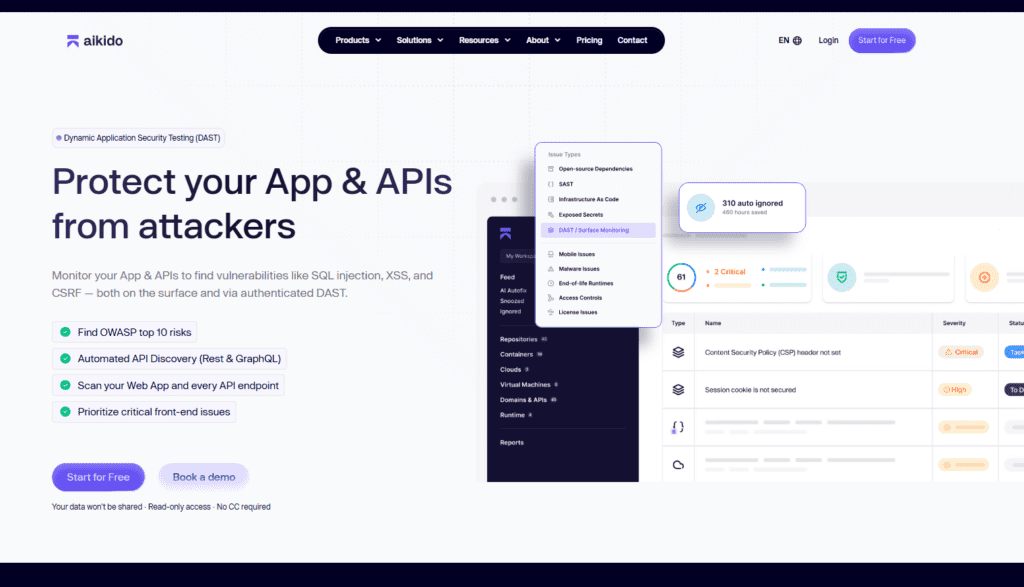
Aikido is a developer-first security platform where DAST is powered by Aikido Attack. This AI agent-based engine goes beyond scanning to actively attempt exploitation, validate findings, and close the loop with automated code fixes. It’s built for teams that want security embedded in their development workflow, not bolted on after the fact.
Pros
- AI agents that chain vulnerabilities and test logic flows, not just known patterns
- Nothing reaches the developer unless it’s been confirmed exploitable; zero false positive noise
- AutoFix PRs mean the fix is ready before the developer even knows there’s a problem
- Whitebox mode uses your actual code and API specs for much deeper coverage
- Aikido Infinite runs automatically on every deployment; always on, always current
- Full security stack in one place; no integration overhead
- Fast. A full pentest in minutes, not hours
Cons
- DAST capabilities are newer and still maturing compared to Invicti’s long-established engine
- Cloud-hosted only; no on-premise deployment option
- Not designed for large-portfolio governance workflows that enterprise security teams may require
- Less suited for organizations that need hands-on, researcher-driven manual testing workflows
Best for
Development and AppSec teams that want AI-driven DAST integrated directly into their development workflow, with automated remediation, continuous retesting, and full AppSec stack coverage in a single platform.
Inviti
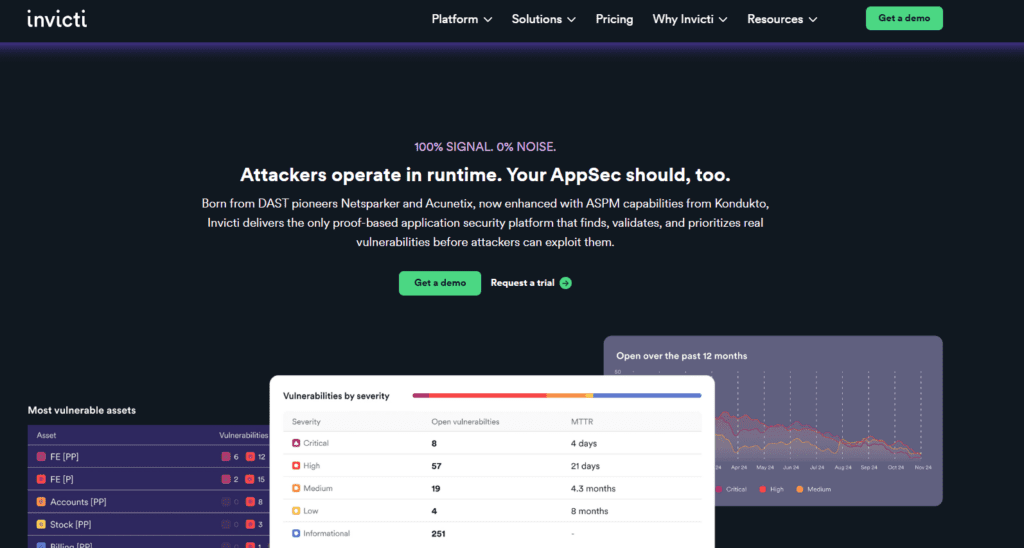
Invicti is a mature, enterprise-grade DAST platform used by over 3,600 organizations globally, and its core claim is proof-based scanning.
Its big thing is proof-based scanning; instead of just flagging a potential issue and moving on, it actually tries to exploit it in a safe, controlled way before surfacing it. If it can’t prove it’s real, it doesn’t show up in your results. They claim 99.98% accuracy, and honestly, reviews back that up.
Pros
- Proof-based scanning is the real deal; findings come with evidence, not just warnings
- Handles REST, SOAP, GraphQL, and gRPC APIs out of the box
- Built to manage 50+ apps from one place; scheduling, governance, and team access controls
- On-premise option for teams that can’t put everything in the cloud
- Added AI-powered fix recommendations in its 2025 update
- Risk scoring that goes beyond generic CVSS numbers
Cons
- No public pricing; you have to talk to sales just to know what it costs
- Scans take 8–10 hours on bigger apps; great for overnight runs, not great for every commit
- On-premise is Windows only, which feels a bit dated
- Heavy JavaScript apps need extra configuration to scan properly
- Getting the most out of it takes time; it’s not a plug-and-play setup
- SAST, secrets detection, IaC; those require integrations with other tools, not built in
Best for
Security teams running large-scale application portfolios that need something proven, scalable, and defensible in a compliance audit.
Side-By-Side Comparison
| Feature | Invicti | Aikido |
| Scanning approach | Proof-based automated scanning | AI agent-based exploitation |
| False positives | Very low | Very low |
| Business logic testing | Limited | Yes |
| Auto remediation | Fix recommendations | Auto-generated PRs |
| Scan modes | Blackbox | Blackbox + Whitebox |
| API testing | REST, SOAP, GraphQL, gRPC | Yes |
| SAST | Via integrations | Native |
| SCA | Yes | Native |
| IAST | Yes | No |
| IaC scanning | No | Native |
| CSPM | No | Native |
| On-premise | Yes (Windows) | No |
| Continuous testing | Scheduled | Per deployment |
| Compliance reports | Yes | Yes |
Which One Wins?
Invicti makes sense if you have a large portfolio, a dedicated security team, and compliance requirements that need a well-documented, proven tool behind them. It’s serious enterprise software, and it earns that label.
Aikido makes sense if security needs to live inside your dev workflow, not beside it. If your team is the one fixing vulnerabilities, not a separate security department, then a tool that finds, confirms, and fixes automatically is worth a lot more than one that generates a report and hands it over.
Both are solid. The question is really: do you need a tool that scales across a security program, or one that accelerates how your developers ship secure code?