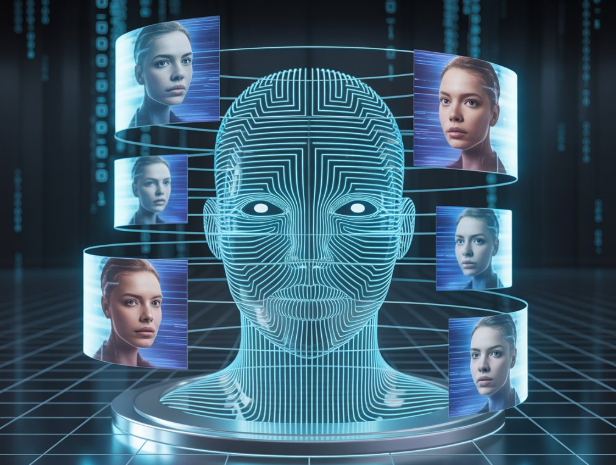
One of the most disputable areas of artificial intelligence is Deepfake Engineering. It is the application of sophisticated machine learning to produce fake media that appears and sounds authentic. Beginning with face-swapped videos and continuing with AI-generated voices, deepfakes have ceased to be a fun internet trick but a powerful creative force, as well as a creative crime-making one. What the world thought was a funny experiment, has now turned into an international security problem.
We will discuss this in this blog, the methods behind Deepfake Engineering, the reasons it has evolved so fast and why effective deepfake detection systems have become essential to online safety.
What Is Deepfake Engineering?
Deepfake Engineering refers to the science and art of synthesizing AI-generated work that can convincingly resemble actual humans. It began with face-swapping applications but currently has turned into complete digital impersonation with voice cloning, lip-syncing editing, 3D modeling and motion capturing. This process is fundamentally grounded on machine learning frameworks, known as Generative Adversarial Networks, or GANs.
In a GAN two AI models are competing against each other. One invents false material and the other attempts to realize it. With time, the generator enhances to the extent that it is hard to tell what is real and what is not. It is precisely a strategy that has contributed to the high convincingly of deepfakes and how harmful they are.
The Good News about Deepfake Engineering.
Despite the fact that the media usually depicts deepfakes as the embodiment of evil, there are also positive uses of Deepfake Engineering. The synthetic actors are applied in the film industry to de-age famous people or to produce characters without the expensive re-shoots. In virtual reality and gaming, the gaming characters are lifelike avatars. Voice cloning is useful in language learning where real-time dubbing in new languages without losing emotion and tone is possible. Speech synthesis is also used to assist patients who lost their voices even in healthcare.
Technology is, however, neutral. What matters is how it is used. And, to be honest, the bad use of DeepFake Engineering is increasing at a greater rate than the good use.
The Dark Uses of Deepfake Engineering.
Deepfake Engineering is now used as a tool of digital fraud. Fraudsters are now engaging in deepfake videos to impersonate corporate leaders on video calls to approve the illegal transfer of money. Voice cloning fraudsters have duped family members and employees into rushing money. Misinformation is being disseminated in political deepfakes prior to elections. The social media is overwhelmed with AI-created influencers and fake livestreamers who do not even live in reality.
What is the most worrying aspect is that it is now possible to make realistic deepfakes in minutes by simple online tools, and this can be done by ordinary people. Actions that used to take an artificial intelligence laboratory are now accessible on a mobile application.
The Reason Deepfake Detection Is so Critical Now.
Due to the increased realistic nature of deepfake content, the use of conventional means of verification such as photo IDs or even basic face recognition is not sufficient anymore. A fraudster is able to produce a live deepfake video of another human being and impersonate that person during authentication. This implies that systems cannot merely identify a face but they have to confirm the presence of a face.
Here the deepfake detection is introduced. In contrast to the human eye, which can be easily deceived, AI-based deepfake detection systems scan digital content to identify the internal anomalies. These might contain inconsistencies in the lighting, unnatural blinking patterns and unstable reflections in the eyes or pixel distortions which cannot be seen by the human eye. In case Deepfake Engineering produces fakes, there is a way to reveal them through deepfake detection.
The operation of Deepfake Detection.
Deepfake detections systems are also able to detect using visual and audio clues. In video recognition, AI models divide the frame by frame of the footage and find compression artefacts, ill-matched shadows and facial inconsistencies. There are models that monitor minute changes in the blood flow beneath the skin by light reflections. Others look at micro-expressions that are hard to copy by the deepfake models.
When detecting the voice, the system will examine the stability of the pitch of the voice, breathing time and smoothness of the waveforms. The vast majority of voice deepfakes do not emulate natural human flaws, including spontaneous stops and human reactions.
Deepfake detection has a bright future with real-time verification. Security tools will follow live feeds and prevent false identities even before they can gain access into a system because there is no need to analyse the recorded videos.
Would Deepfake Engineering Ever Be Controllable?
The problem with Deepfake Engineering is that the detection is progressively getting better, which also leads to a better generation. This has generated an unending cat game-mouse game. New tricks based on AI are employed by fraudsters to break through the deepfakes, and developers react by implementing more powerful interventions.
It might be impossible to have full control but tough regulation and ethics can restrict the harm. Laws against impersonation crimes are being written by governments in different parts of the world as a way of punishing deepfaking. Social media companies are developing watermark technologies to label AI generated content. Liveness detection and passive deepfake detection are being incorporated in the payment providers and financial systems prior to approving a transaction.
The Future of Deepfake Engineering.
The Deepfake Engineering will not fade away. Actually, the entertainment, education and communication will become more widespread with this. The issue is not how to bring it to a halt but how to differentiate between safe use and harmful use.
The use of faces and voices as means of identity verification will no longer be used in the future. In their place, systems will operate a behavioural biometrics such as head movement, pace of blinking or typing. AI will fight AI. The deepfake detectors will be deployed silently in the background of all logins, video calls and online transactions.
There will be no restoration of the pre-deepfake world. Rather, it will be adjusted to one where seeing no longer means believing, and trust will have to be proved by technology.
Final Thought
Deepfake Engineering has provided AI technology with the capability of reproducing reality. It may re-create the past, live-translation, or even create digital humans that cannot be distinguished to the living. However, it is the same power that can be used to cheat, defraud and manipulate.
This is why deepfake detection is the technical and social necessity. With the digital world increasingly synthetic, it is time to save the truth with some brains as well as eyes. It is the people who can find the best deepfakes and not make the most persuasive ones who will shape the future.