
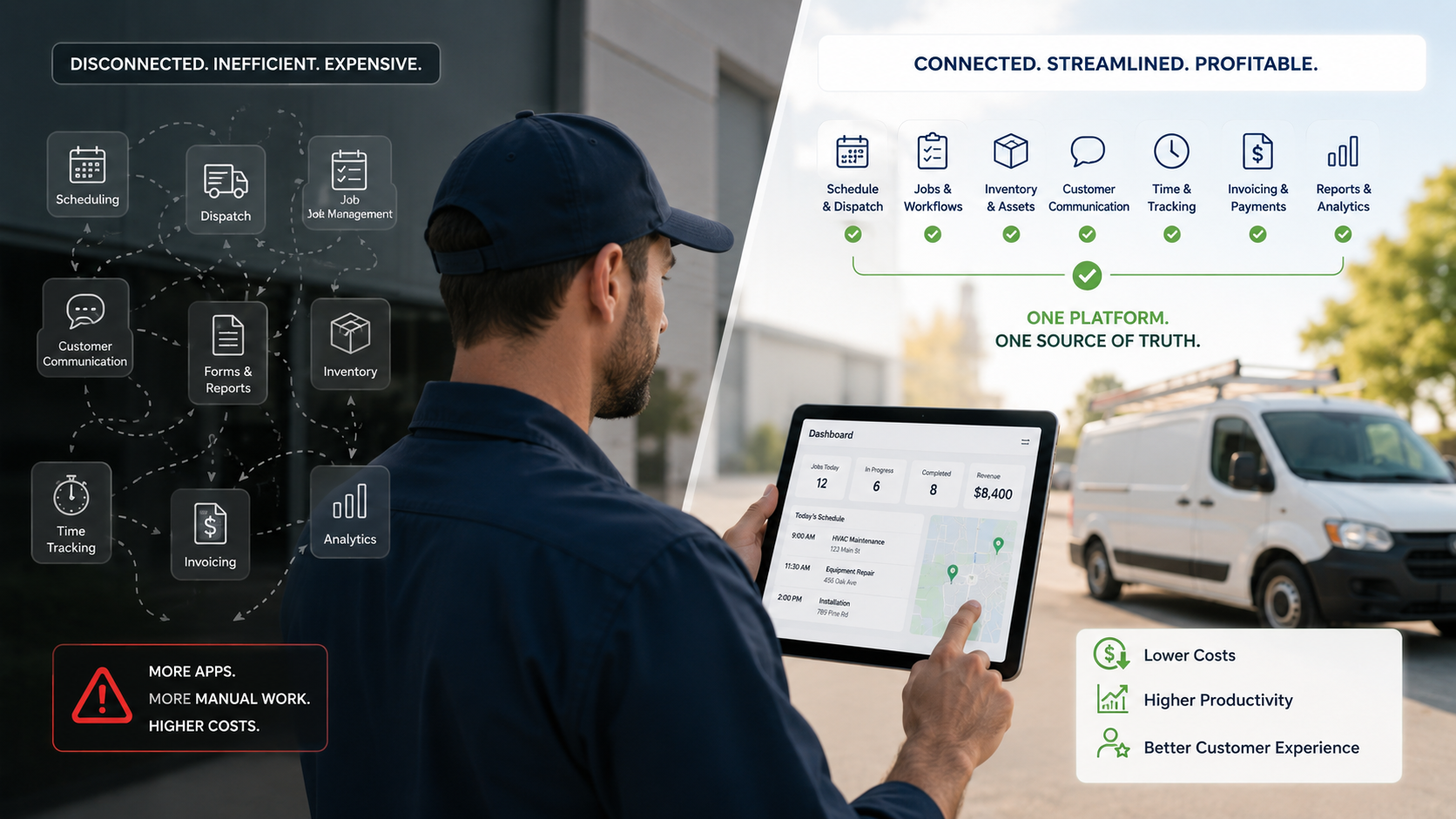
The Customer Call That Exposes the Entire Software Stack
At 7:18 on a Monday morning, a home-service company has twelve technicians on the road.
The dispatcher has one scheduling system open. Customer details live in the CRM. Technicians use a separate mobile app. GPS comes from another provider. Accounting works elsewhere.
Everything appears organized.
Then a customer calls.
The technician was supposed to arrive between 7:00 and 8:00. The dispatcher can see the assignment but cannot tell whether the technician is finishing another job, driving, or waiting on a part. The customer wants an answer now.
This is where technician availability forecasting becomes more than a scheduling feature. To estimate real availability, the business needs current job status, travel time, skill requirements, remaining workload, and technician capacity to agree.
When those signals live in separate systems, the employee becomes the integration.
They call the technician. Check another screen. Update the customer. Change the schedule.
The customer sees one company.
Behind the scenes, that company may be operating as six disconnected ones.
That gap is helping drive the next phase of field service technology: consolidation.
Why Field Service App Consolidation Is Accelerating
For years, the logic behind software buying was straightforward: select the strongest tool for every individual problem.
Need CRM? Buy a CRM.
Need scheduling? Add scheduling software.
Need fleet visibility? Add GPS.
Need mobile forms? Add another application.
Need invoicing? Connect accounting software.
Each decision can be sensible on its own. The problem emerges as the service business grows.
More technicians create more scheduling changes. More customers create more history. More supervisors create more handoffs. More jobs create more billing records. Soon, the business is maintaining relationships between systems almost as much as it is managing customers.
The next generation of field service platforms is moving toward a different principle:
Keep the job context together.
That does not necessarily mean replacing every specialist system. It means deciding which operational functions lose value when separated.
Customer information, scheduling, dispatch, execution, proof, and billing are obvious candidates because they describe different stages of the same service event.
Every Extra App Creates Another Handoff
Software fragmentation sounds technical.
In practice, it usually looks surprisingly ordinary.
Dispatch to Field
A dispatcher changes an appointment from 2:00 to 12:30.
Does the technician immediately see the current instruction?
Does travel planning change?
Does the customer receive the correct update?
Does another employee have to copy the change somewhere?
One scheduling adjustment can cross four applications before the customer sees the result.
Every boundary introduces a chance for delay or mismatch.
This is where Service Wand’s approach is relevant. CRM, scheduling, routing, dispatch, field execution, billing, reporting, and automation operate within a connected environment rather than requiring each stage to recreate the job.
The competitive advantage is not simply fewer tabs.
It is less operational translation.
Field to Billing
The second handoff is often more expensive.
A technician finishes a repair, adds a part, takes photos, records an additional recommendation, and closes the appointment.
What happens next?
If accounting has to interpret those field notes, re-enter materials, confirm what was approved, and ask the technician what happened, the workflow is not actually complete.
The job ended in the field.
The administrative work did not.
Consolidation matters because completion data should be usable by the next stage of the business without being rebuilt.
What a Unified Field Service Platform Should Connect
“All-in-one” can become meaningless if it simply describes a long feature list.
The better test is continuity.
A connected field service operation should preserve several relationships.
The customer request should remain attached to the scheduled work.
The scheduled work should remain attached to the technician assignment.
The assignment should retain relevant customer, asset, and service history.
Field activity should create the service record.
The service record should support customer communication and proof of completion.
Approved work should flow toward billing.
That is different from merely placing CRM, scheduling, and invoicing under the same company logo.
Buyers should test whether the underlying workflow is actually connected.
Change the customer information. Does the current job reflect it?
Reassign the technician. Does everyone who needs that information see the new assignment?
Add approved work in the field. Can billing understand where the charge originated?
If users repeatedly export, copy, synchronize, message, or reconcile information, consolidation may exist commercially without existing operationally.
The Profit Leak Lives Between Systems
Fragmentation has a direct cost, but it rarely appears as one line on the P&L.
It appears as minutes.
Proof of Service Protects Trust
A customer says a technician never explained why additional work was necessary.
The technician remembers the conversation. Photos exist. Notes exist. An approval may exist too.
But if those pieces are scattered across several systems, account staff have to reconstruct the visit.
Customer trust declines when the business cannot quickly explain its own work.
Strong proof of service is therefore more than documentation. It is a customer-experience capability.
A connected service history allows someone who was never onsite to understand what happened without starting an internal investigation.
Billing Turns Friction Into Cash-Flow Delay
Billing exposes fragmentation particularly well.
When technicians, operations, and finance maintain different versions of a job, invoices wait.
Someone needs a missing part number.
Someone verifies labor.
Someone checks whether the customer approved the additional work.
Someone searches for the service notes.
Individually, these interruptions look small. Across hundreds of monthly appointments, they become administrative capacity that could have been avoided.
This is why consolidation should be evaluated through profitability rather than subscription count.
Replacing four software bills with one is nice.
Removing four manual handoffs from every job is much more valuable.
A Practical Consolidation Test
Service companies do not need to replace their entire technology stack tomorrow.
They should first discover where fragmentation is costing them money.
Choose twenty recently completed jobs and trace each one through five stages:
Request → Dispatch → Execution → Proof → Billing
At every transition, ask:
- Did information transfer automatically?
- Did anyone re-enter existing data?
- Did someone have to search another system?
- Was a phone call or message required to clarify status?
- Did customer context survive the handoff?
- Could billing explain every charge from the service record?
Then count the manual bridges.
That creates a useful metric: Handoffs Per Revenue Job.
A business averaging seven manual handoffs for every completed appointment has a very different consolidation opportunity from one averaging one or two.
This is where the market is heading.
AI will make the direction even clearer. Automation and intelligent scheduling are only as useful as the operational context available to them. An AI assistant cannot reliably reason about technician capacity if the schedule, customer history, job progress, and resource availability disagree.
The great field service app consolidation is therefore not really about having fewer apps.
It is about creating fewer versions of the truth.
Customers get more accurate arrival information.
Dispatch gets clearer field status.
Technicians receive better context.
Proof stays with the job.
Billing starts with completed operational data instead of an investigation.
And management spends less time connecting pieces that should never have been separated.
That is not simply software consolidation.
It is an operating-model change.