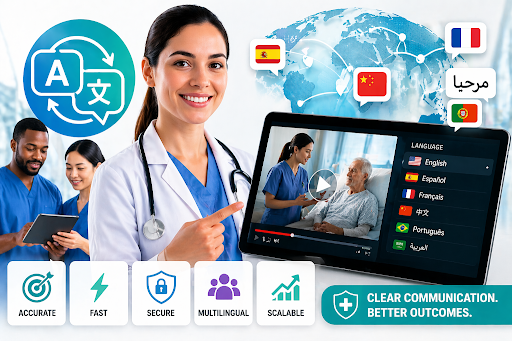
Healthcare organizations communicate in video more than ever. Patient onboarding videos, clinical training modules, informed consent explainers, and staff compliance training are now baseline expectations. For hospitals serving multilingual patient populations or training global clinical teams, the language gap between the video producer and the viewer is the single biggest quality-of-care risk that most systems have not yet addressed.
AI video translation solves this. The right video translation tool processes a clinical training video or patient education clip into 20 or more languages in a few hours, with audio dubbed in the patient’s language and subtitles synced per clinic region. This piece covers the platforms that actually handle healthcare content, including the compliance requirements that separate them from generic tools.
Key Takeaways:
- Healthcare video translation requires compliance features that most generic AI tools lack: HIPAA-compatible data handling, SOC 2 certification, and controlled biometric data processing
- Patient education videos in the patient’s native language correlate with 30% to 50% higher health literacy scores and lower readmission rates in published studies
- Clinical training videos are long-form, multi-speaker, and terminology-heavy, which narrows the list of usable platforms
- Leading 2026 platforms for healthcare: Rask AI, Synthesia, Acolad, Wordbee, and specialized healthcare localization vendors
- Total cost of ownership matters more than per-minute pricing because of regulatory review, QA, and ongoing content updates
Why Healthcare Is a Higher Bar
Most AI video translation platforms were designed for marketing, e-learning, or creator content. Healthcare adds requirements these tools often do not meet.
Compliance and data handling
Patient education videos often reference specific conditions, treatments, or case studies. The platform processing these videos may hold PHI (protected health information) in transcripts, subtitles, or metadata. Under HIPAA in the US and equivalent frameworks elsewhere, this requires a signed Business Associate Agreement (BAA), encrypted storage, and audit-trail logging.
Generic AI dubbing tools rarely offer these. Platforms that target healthcare specifically do.
Terminology accuracy
A patient education video about “myocardial infarction” cannot become “chest muscle damage” in the Spanish version. Clinical terminology must translate to the corresponding recognized term in the target language. Glossary control and review workflows are not optional.
Accessibility requirements
ADA Section 508 in the US, EN 301 549 in the EU, and WCAG 2.1 internationally all require closed captions, audio descriptions for visual content, and readable transcript access. Platforms that export properly timed captions and transcripts in every language language meet this by default; others add manual work.
Long-form clinical content
A surgical training video may run 45 minutes with multiple speakers, procedural voiceover, and on-screen graphics. Platforms optimized for 30-second marketing clips often fail on this length and complexity.
What Healthcare Teams Should Evaluate
SOC 2 and HIPAA compatibility
SOC 2 Type II certification is the baseline. For US healthcare, the platform should also sign a BAA or explicitly support HIPAA-aligned data processing. Ask directly and require it in writing before any PHI touches the platform.
Voice cloning for recurring clinicians
A clinic’s head nurse recording 40 patient education videos builds recognition with patients. Voice cloning preserves that recognition in Spanish, Mandarin, or Vietnamese versions. For one-off training videos with rotating speakers, generic AI voices are usually acceptable.
Multi-speaker detection for training content
Clinical training often includes a physician, a nurse educator, and a simulated patient. Each voice needs its own dubbed version, matched to the same speaker across languages.
Terminology management
A controlled vocabulary of clinical terms, locked to their ICD-10 or MeSH equivalent translations, prevents drift across hundreds of videos. This is especially important for systems producing thousands of training videos yearly.
Caption and transcript export
SRT, VTT, and plain-text transcript files per language are table stakes for ADA compliance. Some platforms also export SBV or TTML formats used by specific hospital CMS systems.
Review workflow
Clinical SMEs must approve translations before publication. A tool without a built-in review and approval workflow forces the team into parallel email threads, which kills the time savings the AI provided.
Leading Platforms for Healthcare Video Translation in 2026
Rask AI
Best for: health systems and medtech companies producing patient education and clinical training video at scale.
Strengths: 130+ languages for translation and dubbing, voice cloning in 32 languages preserving clinician voice across patient ed series, Translation Dictionary for locked clinical terminology, multi-speaker detection for training videos, SOC 2 Type II certified, API for integration with hospital CMS and LMS systems, Teamspaces for reviewer workflows.
Limitations: voice cloning limited to 32 languages. HIPAA-specific BAA arrangements are negotiated at the enterprise tier rather than the standard plan.
Pricing: subscription with free trial, enterprise tier with custom compliance.
Synthesia
Best for: avatar-based compliance training where the speaker is a presenter rather than a specific clinician.
Strengths: 140+ languages, strong avatar library, SOC 2 certified, used by several large hospital systems for standardized compliance training.
Limitations: avatar-centric, not well-suited for localizing existing clinician footage. Best for training built avatar-first.
Acolad (formerly Amplexor / Technicis)
Best for: regulated clinical content requiring human-in-the-loop review, such as FDA-submitted training or multi-site clinical trial videos.
Strengths: dedicated healthcare and life sciences practice, ISO 17100 and ISO 18587 compliant, mature review workflows, backed by human medical translators.
Limitations: higher cost and slower turnaround than pure AI platforms. Better suited to regulated submissions than day-to-day patient ed.
Wordbee
Best for: hospital systems with existing TMS deployments managing multilingual text plus video as a single workflow.
Strengths: translation management platform with video integration, glossary and TM management, human translator workflow built in.
Limitations: less focused on AI-first video dubbing. Better for systems already using a TMS for text content who want to extend into video.
Transifex / Smartling (hybrid approach)
Best for: systems using general localization platforms that integrate with video dubbing APIs.
Strengths: mature enterprise localization workflow, strong glossary and term management.
Limitations: video is a bolt-on capability rather than a first-class feature. Systems that produce mostly video content are better served by video-first platforms.
Comparison Table
| Platform | Languages | Voice Cloning | SOC 2 | HIPAA-compatible | Multi-Speaker | Healthcare focus |
| Rask AI | 130+ | 32 languages | Yes | Via BAA at enterprise tier | Yes | Patient ed, clinical training |
| Synthesia | 140+ | Avatar-based | Yes | Negotiated | No | Compliance training |
| Acolad | 100+ | Limited | ISO certified | BAA available | Partial | Regulated clinical content |
| Wordbee | Varies | No | Yes | BAA available | No | TMS-based workflow |
| Smartling | Mostly text | N/A | Yes | Negotiated | N/A | General enterprise loc |
Cost and ROI in Healthcare
A typical US hospital producing 100 patient education videos per year in 5 languages at traditional translation rates pays roughly $300,000 to $500,000 annually. Most hospitals do not spend this; they either skip languages entirely or translate subtitles only.
AI workflows cut the cost and let more languages get covered. Realistic numbers:
| Approach | Per-video cost (5-lang) | Annual cost (100 videos) | Languages per video |
| Traditional agency dubbing | $3,000 to $5,000 | $300,000 to $500,000 | 5 (more = expensive) |
| Hybrid (AI + clinical reviewer) | $400 to $800 | $40,000 to $80,000 | 5 to 15 |
| Full AI workflow | $50 to $150 | $5,000 to $15,000 | Up to 30 |
The difference in language coverage matters most. Full AI workflows let a hospital cover 15 languages instead of 5, which maps directly to the languages its patient population actually speaks.
Outcome Metrics That Matter in Healthcare
The ROI case in healthcare is not view count. The metrics that move clinical leadership are different:
- Patient health literacy scores on post-education assessments, by language
- Pre-procedure consent completion rates in the patient’s preferred language
- Staff certification completion rates on translated training modules
- Readmission rates segmented by whether the patient received language-matched education
- Patient satisfaction (HCAHPS or equivalent) in the communication section
Published studies show 30% to 50% improvements in several of these metrics when patients receive education in their native language with culturally appropriate framing. The ROI case writes itself when leadership sees the readmission or satisfaction numbers tied to language access.
Which Tool Fits Which Use Case
Patient education library (outpatient clinics, health plans): Rask AI for the broadest language coverage and voice cloning that preserves the clinician relationship across the series.
Regulatory-submitted training (FDA, EMA): Acolad or a similar human-led firm, because the regulator expects human translator attestation.
Ongoing compliance training (annual HIPAA refreshers, OSHA, etc.): Synthesia for avatar-first training that does not require a specific clinician’s voice.
Multi-site health system with existing TMS: Wordbee or Smartling if the TMS is already in place, or Rask AI as a video-first replacement if the TMS is being reconsidered.
Telemedicine follow-up videos (personalized for the patient): Rask AI or a similar API-first tool for programmatic integration with EMR or patient portal.
Conclusion
Healthcare video translation is a higher bar than most industries. The platforms that clear it combine broad language coverage with the compliance, terminology, and reviewer workflows that clinical content demands. Generic AI dubbing tools built for marketing rarely meet this standard.
For patient education and clinical training at scale, Rask AI offers the widest language coverage and voice cloning with SOC 2 compliance in one platform. For regulated submissions, traditional human-led firms remain the safer choice. For compliance training at scale, avatar-based platforms like Synthesia work well. The right pick depends on the content type and the regulatory exposure. Most health systems need more than one tool for different content categories, not a single platform for everything.