Introduction
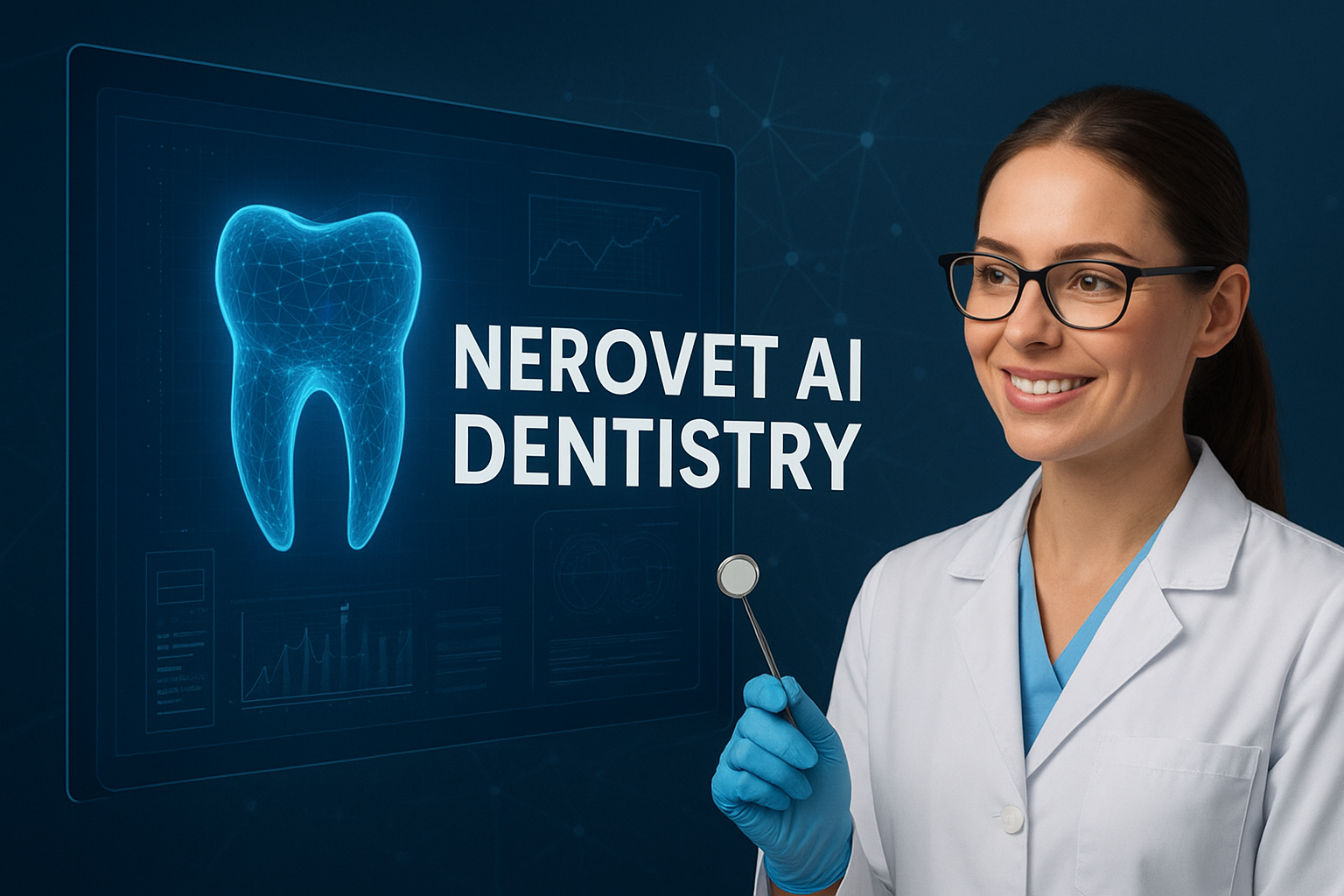
Nerovet AI Dental is the name that’s been popping up across blogs and tech sites in 2025 as another entrant in the rapidly growing field of dental artificial intelligence. The claims are familiar: automated radiographic reading, earlier detection of caries and periapical disease, treatment-planning suggestions, and workflow automation that “helps dentists and patients.”
But the online footprint for Nerovet is mostly third-party write-ups and short promotional posts rather than an obvious, well-documented corporate site or peer-reviewed evaluations. That matters: when a clinical tool is new (or poorly documented), clinicians and patients should look for published validation, regulatory status, data-privacy details, and real-world case studies before adopting it.
This article pulls together what’s currently visible from public search results, explains how dental AI generally works, compares Nerovet’s public claims to established vendors, and gives practical steps for dentists and patients to evaluate the product safely.
What exactly is “Nerovet AI Dental”?
Most of the pages mentioning Nerovet describe it as an AI platform for dentistry: imaging analysis (bitewing, panoramic, CBCT), lesion detection, automated measurements (e.g., bone loss), risk prediction, and patient-communication tools (visual simulations, chat assistants). Several recent posts present these features as the product’s core offering and emphasize interoperability with common imaging formats (DICOM) and practice-management systems.
Key take-aways:
- The feature set claimed (imaging flagging, predictive analytics, personalized plans) is consistent with many dental-AI tools.
- At the time of writing, I could not find a clearly documented official corporate site, clinical validation papers, or regulatory filings for Nerovet on major medical-device registries — which increases the need for caution.
How dental AI (the class of tools Nerovet belongs to) actually works — plain language
- Data input: digital X-rays, CBCT volumes, intraoral scans, patient chart data.
- Image preprocessing: the AI cleans and standardises images so models can analyse them consistently.
- Model inference: trained machine-learning models (usually convolutional neural nets for images) scan for patterns: radiolucencies, anatomical landmarks, margins, bone levels, etc.
- Scoring & explanation: outputs are given as flagged regions plus confidence scores; the best systems also show why they flagged something (heatmaps, measurement overlays).
- Human review: a dentist reviews flags, confirms or rejects them, and makes the final clinical decision.
These systems reduce routine reading time and surface subtle patterns, but they don’t replace professional judgment. High-quality vendors publish validation studies (sensitivity/specificity, inter-reader comparisons) and provide audit trails. If a vendor cannot show validation, that is a red flag.
What the search results show about Nerovet today (summary of evidence)
- Multiple blogs and small tech-sites have posted promotional-style explainers describing Nerovet’s features and benefits; many posts were published in mid-late 2025. These articles broadly echo the same claims about imaging analysis, predictive planning, and workflow gains.
- An investigative/critical post pointed out the absence of a clear “about us”, regulatory information, or independent clinician endorsements — and urged caution until more concrete documentation appears. That is important because clinical AI tools should be transparent about datasets, validation, and data‐security practices.
- Some sources suggest a veterinary angle (similarly named products or confusion with “NeroVet/Neovet”), so be careful: similar names in the animal-health space can cause mistaken assumptions about human-dental applicability. Always verify you are looking at the correct product.
How Nerovet’s public claims compare with established dental-AI vendors
There are known, well-documented dental AI companies that publish clinical validations, customer case studies, and regulatory information. Those vendors typically show peer-reviewed studies or independent audits and have visible customer references. Nerovet’s current online trail looks more like early marketing coverage rather than a mature vendor dossier. For clinicians, this matters because product maturity correlates with predictable performance, documented limitations, and clear legal/regulatory responsibilities.
Clinical and legal checklist for dentists considering Nerovet (or any new dental AI)
If you’re a dentist or decision-maker evaluating Nerovet, run these checks before a pilot:
- Identity & team: Can you find a company website with team bios, office address, and business registration? If not — ask for it.
- Validation data: Request sensitivity/specificity, ROC curves, and the datasets used (size, diversity, annotation protocol). Are there independent studies or third-party audits?
- Regulatory status: Is the tool marketed as a diagnostic device? If yes, does it have local approvals (e.g., FDA EUA/clearance in the U.S., CE marking in EU, or equivalent)? Lack of registration doesn’t always mean unsafe, but it raises legal considerations.
- Data security: Ask where imaging and records are stored, encryption standards, retention policies, and whether data leaves your jurisdiction (important for GDPR, HIPAA, etc.).
- Interoperability & workflow: Verify DICOM support and how outputs appear in your charting software. Is dual-read support available (AI + clinician)?
- Liability & contracts: Clarify who is responsible for errors. Get a written SLA, indemnity clauses, and exit/data-return terms.
- Pilot design: Start with non-critical cases, keep parallel human reads, and measure discrepancy rates and time saved.
If you’re a patient: what to ask your dentist about Nerovet (or other AI tools)
- “Is my dentist using an AI tool to read my X-rays? If so, which one?”
- “Has this tool been validated in clinical studies and is it approved by regulators?”
- “How does the tool protect my data and who can access my scans?”
- “Will the AI decision replace or only assist my dentist?”
- “Can I see the images/flags the system produced?”
Good clinicians will welcome these questions; if you encounter evasiveness, that’s a signal to seek clarity or a second opinion.
Common limitations and concerns with early AI dental products
- Training bias: If models are trained mainly on a narrow demographic, performance can suffer on different populations.
- False positives/negatives: AI may flag harmless variations or miss subtle pathology — both have consequences.
- Over-reliance risk: Clinics that depend too heavily on AI can degrade human reading skills unless they maintain dual-read protocols.
- Data privacy & export: Some tools send data to cloud servers in other countries; that raises legal and ethical issues.
- Vendor transparency: Early or low-visibility vendors sometimes lack clear validation or responsible-use documentation. That appears to be the main gap currently visible for Nerovet.
Practical scenario: how a safe Nerovet pilot would look (recommended approach)
- NDA + data-use agreement that limits data export and ensures patient de-identification.
- Small controlled pilot (e.g., 200 cases) with dual reads and blinded comparison to current standards. Track time saved, discrepancy rate, and clinician confidence.
- Weekly review meetings to tune thresholds, annotate failure modes, and refine the integration.
- Patient consent language updated to include AI-assisted reads where applicable.
- Exit plan that returns/removes all practice data on contract termination.
Signals that suggest a dental-AI vendor is trustworthy (EEAT checklist)
- Expertise: clinical team with dental specialists and AI researchers; published papers.
- Experience: real-world case studies, customer references, and measurable outcomes.
- Authoritativeness: independent validations, peer reviews, and recognized partnerships with dental schools or DSOs.
- Trustworthiness: clear privacy policy, regulatory declarations, and transparent support/SLA.
For Nerovet, many public posts describe the technology but the searchable evidence for the above EEAT pillars (especially authoritativeness and trustworthiness) is currently thin compared with established players. That doesn’t automatically mean the product is bad — only that you should ask hard questions and request documentation before adoption.
5 FAQs (People Also Ask style) about “nerovet ai dental”
- What is Nerovet AI Dental and what does it do?
Nerovet is described in recent online posts as an AI platform for dental imaging and workflow support (image flagging, risk prediction, treatment planning). Public descriptions are promotional and appear on third-party blogs. - Is Nerovet AI Dental clinically validated?
As of the present search, there is no clear public record of peer-reviewed validation studies or regulatory filings linked directly to Nerovet; ask the vendor for independent validation or third-party audits before using clinically. - Does Nerovet replace the dentist?
No. Like responsible dental-AI tools, Nerovet (based on how it’s described) appears to be an assistive technology — it flags findings and provides risk estimates, leaving final diagnosis and treatment decisions to the dentist. - How does Nerovet handle patient data and privacy?
The public posts reference encryption and logging as typical measures, but specific policies (hosting location, retention, de-identification process) were not clearly documented in the sources found. Request a data-protection white-paper and contract clauses before sharing patient data. - How does Nerovet compare to established dental AI companies?
Functionally it claims similar features to established vendors, but unlike some recognized companies that publish validation and regulatory status, Nerovet’s public footprint is mostly promotional content. Compare published evidence and regulatory status side-by-side before choosing.
Bottom line: cautious interest, not blind adoption
Nerovet AI Dental is one of several new AI-branded dental solutions appearing in online search results in 2025. The described features (automated imaging reviews, predictive analytics, and workflow integrations) are familiar and potentially valuable — but the publicly available evidence about Nerovet’s validation, regulatory standing, and vendor transparency is limited.
That doesn’t mean it will fail; it means dentists and procurement leads should require the usual EEAT documentation and run disciplined pilots with safeguards. Patients should ask direct questions and expect informed consent when AI tools are used in their care. If you’re evaluating Nerovet, insist on written validation, data-security guarantees, and a small controlled pilot before any clinical reliance.
Read More: Autocracy Unveiled: Understanding the Power of One Rule
Conclusion
AI in dentistry can improve early detection, speed routine reads, and make treatment conversations clearer — but the technology is only as trustworthy as the evidence behind it.
Nerovet AI Dental shows up in many recent web write-ups claiming imaging analysis, predictive planning, and workflow gains, yet a clear official footprint (company site, published validations, or regulatory declarations) is either hard to find or absent from public search results. That gap matters: clinical adoption should follow documented validation, transparent data-security practices, and legal clarity about responsibility. For clinicians: request datasets, independent audits, pilot metrics, and contractual protections before integrating Nerovet into patient care.
For patients: ask your dentist whether AI was used, which product was involved, and how your data is protected. When used with proper verification and safeguards, dental AI can be a practical assistant — but until Nerovet demonstrates published evidence and transparent governance, treat it as an emerging product that requires careful vetting.