eSIM vs Roaming vs Local SIM in Europe: What Actually Costs Less
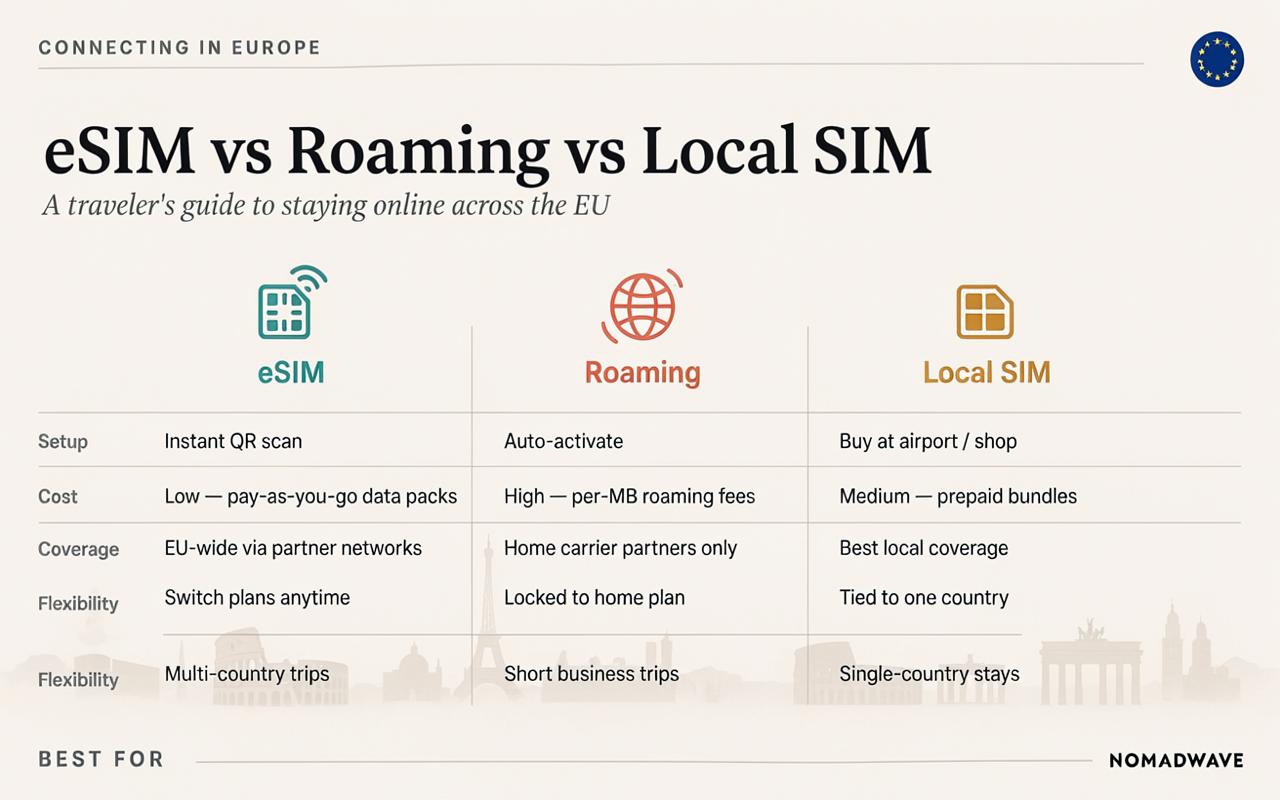
There are three realistic ways to get mobile data on a trip to Europe: pay your home carrier’s roaming fee, buy a local prepaid SIM when you arrive, or install a travel eSIM before you leave. They are priced on completely different models, which is why the “cheapest” option flips depending on how long you are going and how many borders you cross.
Here is how the three actually compare.

ALT: The Rialto Bridge in Venice, a common stop on a multi-country European trip
First, a note on why EU roaming rules do not help you
Europe abolished roaming surcharges in 2017 under the Roam Like At Home regulation. It is genuinely good policy and it is also the source of most of the confusion, because it only applies to SIMs issued inside the EU or EEA being used inside the EU or EEA.
If your line is with a US, Canadian, Australian or Asian carrier, none of it applies to you. And since Brexit, UK carriers are no longer bound by it either, so several have reintroduced daily fees for EU travel. Check your specific plan rather than assuming.
Option 1: Carrier roaming
Pricing model: a flat daily fee per line, charged on any day you use data.
Most major carriers now sell some version of a travel day pass, typically in the region of ten to fifteen dollars a day, which lets you use your normal domestic allowance abroad. Some premium plans bundle a number of free days.
Where it wins: short trips. If you are in Europe for three days, a day pass is often cheaper than anything else once you account for the convenience of keeping your own number active for calls and SMS.
Where it loses: everything longer. A ten-day trip at twelve dollars a day is a hundred and twenty dollars, per line. For a family of four, that is a meaningful chunk of the holiday budget spent on data you are barely using. Also watch for how the day is defined. Most carriers charge for a full 24-hour block triggered by any use at all, so one background app sync at 11pm can cost you a full day.
Option 2: A local prepaid SIM
Pricing model: cheap per gigabyte, but bought per country.
Prepaid data in most of Europe is genuinely inexpensive. Bundles with generous allowances are common and often come with a local number. If you are spending a month in one place, this is usually the lowest cost per gigabyte you will find.
Where it loses: the moment your itinerary has more than one country, and the moment you value your time. You have to find a shop, present ID (registration is mandatory in most European countries), and get the SIM provisioned in a language you may not speak. Airport kiosks solve the convenience problem and charge a premium for it.
The multi-country issue is the bigger one. An Italian SIM used in Croatia is roaming, and while EU rules cap that, most prepaid bundles include a fair-use ceiling that a two-week multi-country trip will run into.

ALT: Traveler checking her phone outdoors while abroad
Option 3: A travel eSIM
Pricing model: a fixed price for a data bucket and a validity window, bought before you go.
You pay once, install a digital profile over Wi-Fi at home, and the profile roams onto local partner networks when you land. No shop, no ID paperwork, no SIM tray.
The distinguishing feature for Europe specifically is regional coverage. A single-country eSIM has the same border problem as a local SIM, but regional Europe eSIM plans cover 30-plus countries across the EU and UK on one profile, so a Lisbon to Madrid to Paris trip runs on the same plan without you touching anything. Pricing tends to sit in the low single digits for a small weekly bucket and in the twenty to forty dollar range for the 10GB to 20GB monthly plans most travelers end up buying.
Where it loses: it is data-only. You get no local number, so anything that insists on SMS to a real phone number needs your home line kept active in the background. And it needs an eSIM-capable, unlocked phone, which rules out older handsets. The install process is straightforward but does have a few settings that matter, covered here in a walkthrough on how to use an eSIM while traveling.
The short version
| Trip profile | Cheapest option |
| 2 to 4 days, one country | Carrier day pass |
| 1 to 3 weeks, multiple countries | Travel eSIM |
| A month or more, one country | Local prepaid SIM |
| Any trip, multiple travelers | Travel eSIM per person |
The crossover point sits at roughly five days. Below that, the flat daily fee and the convenience of keeping your own number usually wins. Above it, the maths turns hard against roaming and stays there.
Whichever you pick, do one thing before you fly: go into your settings and turn data roaming off on your home line. That single toggle is what separates a planned expense from a bill you argue about when you get back.